 Mfundo Ndima
A change in technology changes how we do things. It also changes how we think, especially with the new technology in hand. The technological inventions over the years have completely transformed our lives. What is noteworthy in inventions is that it finds an alternative to doing something much faster and cheaper. This has also been the case in economies across the world. Economies have changed dramatically over centuries due to man innovativeness and inventions.
The change in technology begs us to be always proactive. To foresee the consequences of changes and act accordingly to mitigate the negative effects it might have on society, is imperative. For example, we have seen supermarkets shifting from needing a physical address to needing a website domain (less labour required). The invention of Amazon is a prime example. We have also seen a shift from paper to digital simply because of space availability and need. This has dramatically changed how societies communicate, live, and think.
In clear terms, sectoral shifts are changes in the composition of labour demand among industries and regions due to, mainly, technological changes and new international trade agreements. This results in frictional unemployment where people voluntarily change their jobs. Employees continue to phase out themselves from industries that no longer require their labour and pursue jobs in industry that need their skills. Massive unemployment will then be recognized in economies that have not fully equipped their work force to get jobs in the new demanding industries. This might be the case with the South African workforce as it bares high level of unemployment.
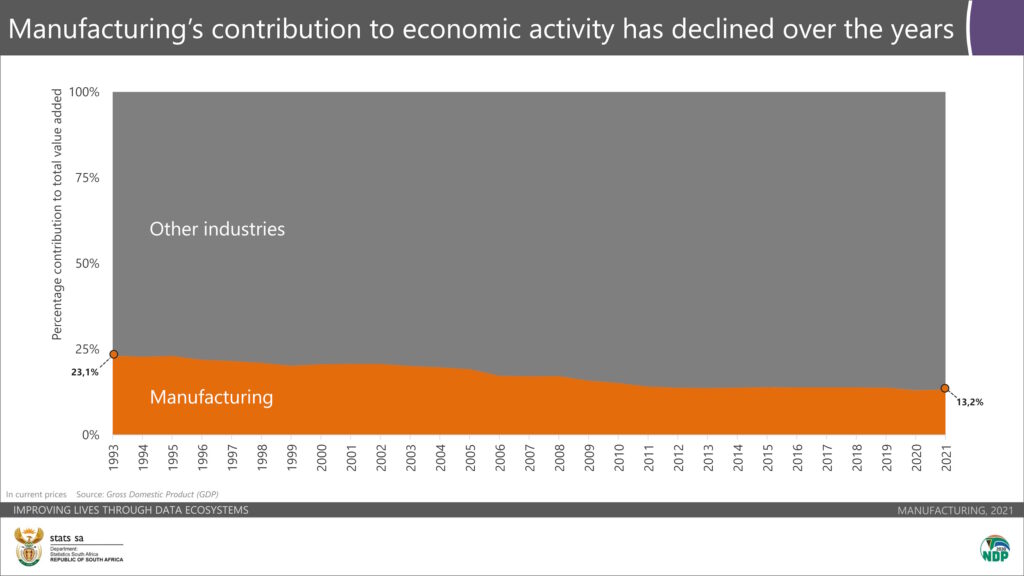
Over the years, the South African economy has recognized a decrease in the contribution of manufacturing to national economic activity, declining from 23.1% in 1993 to 13.2% in 2021. The industry lost almost 309 000 jobs over 16 years and recorded a decline in employment. This reveals a shift in the composition of labour demand in the manufacturing industry, from needing a man who can make a bottle with his hands to needing a man who can operate and maintain a machine which can produce the same bottle ten times faster and cheaper. Do bare in mind that this is one example amongst numerous others.
Comparatively, South Africa has seen growth in the tertiary sector since the 2000’s, especially in the financial, communication, and transport sectors. Indeed, this has provided employment for many people but a gap in qualification, experience, and skills is recognized. This is how the high levels unemployment are justified. It is only the state that can intervene and ensure that the workforce is rightly skilled, experienced, and qualified to obtain jobs in the growing sectors.
What is important then is ensuring that the skills of the workforce changes coincidently with the composition in labour demand. Firstly, this can be done through having a flexible-adaptable education system which directly and proactively addresses these changes in labour composition demand. Secondly, through government monitoring the changes and the upcoming changes in industries so to have policies that relate to people and their reality. Lastly, the state being in the center of every development allows the prioritization of people rather than profit maximization.
The South African economy is hindered by many problems, but a willing and thoughtful government can change it all. Public participation in policy making has never been more important since many government policy makers have lost touch with the people’s reality, many becoming Petite Bourgeoisie. Sectoral shifts happen in many big and small economies across the globe, but it has been the government’s willingness that has been able to mitigate the negative effects.
-MediaHouse150