 Mfundo Ndima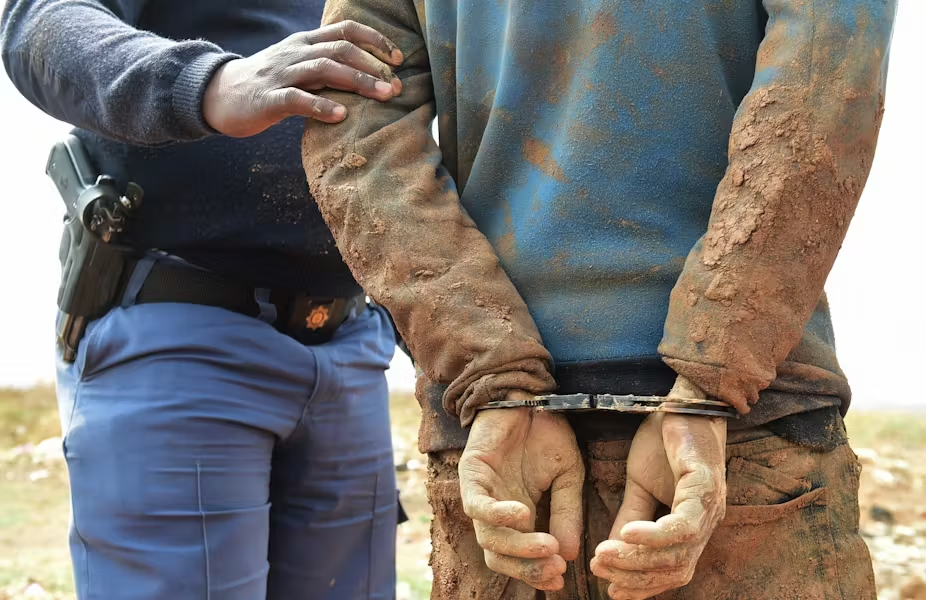
There is no easy line of words in which we can characterize nor elaborate the prevailing setting of our nation, South Africa (SA). At least to me I can settle with the fact that as a nation we are a fractured skull, and the memory loss coupled with paralysis is there to show. Our neglect of contentious debates and ignorance will continue to show it effects on the economy, politics, culture, and the social fabric at large.
Our mainstream media currently is engulfed with an ‘illegal miners’ conundrum. The recent government effort of operation Vala Umgodi to crack down on Stillfotien and Sabie Zama Zama’s is just like boiling the ocean. Even the differing public views to rescue or let be the Zama Zama’s are views without substance, proving either memory loss or just acute ignorance. This matter is a conundrum perfected by two points which are my focus in this piece.
Firstly, what you see in the media highlights the mafioso character of the mining industry in SA. This probes more questions on the neglected debate of the Land Question. On a track period of thirty years into democracy, the assertion of an untransformed economic base maintaining exploitation and exclusion (particularly race exclusion) is valid and accurate, why? This begs us to review not only the superstructure, but also the modes of production prevalent in our economy and society.
Secondly, what you see and learn on the media is a case highlighting our broken state duty and function to administratively monitor cross border movements. The brokenness of this function solely lies on a lack of bureaucratic willingness to design policy that serves for society. Rather, we see much more willingness to protect the status quo which has proven to exert social unrests. This draws me to conclude on this point emphasizing that SA has never had a government of the people, but SA has a government for the markets, and which pleases stomachs and egos of particular mafias.
A mafioso character of the mining industry.
How bad is wealth concentration in the South African economy? A wealth inequality study by Chatterjee et al (2022) reveals that in the period of 1993-2017 the top 1% of South Africans own 95% of the financial and physical assets. Moreover, the top 10% of households in SA own 71% of the country’s wealth further earning 700% more than the bottom 40%. Is this just natural inequality or designed exploitation of the masses by the few?
There are three large mining companies in SA excluding state owned African Exploration Mining and Finance Corporation (AEMFC). These mines work based on private ownership which by its essence of design is to benefit those who organize the factors of production and bare the risk. However, the consequences of such are the exclusion of the vulnerable who can’t bare the risk of capital contribution, and the concentration of wealth and prioritization of profits which in a clear sense is process creation of value for exploitation. Let that sink in a bit!
In simple terms, as a nation we have a mineral industry which is designed to never benefit the people and the state. Rather, it is designed to be operated and bought by the highest bidder. This makes it no different in comparison to a mafia which dictates what go’s and what is in that industry. On extreme arguments, this characterization can fit the entire design of the South African economy.
It is clear from here that the current Stilfontein and Sabie case engulfing mainstream media is a consequence of industry design. Cecil John Rhodes design of the industry is indeed still prevalent, worryingly, it is prevalent in a period which is supposed to be ‘inclusive’ and native origin centered.
Government duty
What legitimizes states formation in political philosophy is the idea of a social contract which came with Thomas Hobbes extended by Jean-Jacques Rousseau. This contract asserts the willing subjugation of society to the state to avoid a state of nature, reciprocally, the state provides for and protects society to maintain order. This is the Eurocentric state definition and formation.
The case of Stilfontein has revealed what is already know to the public, which is a slacking border control. To some degree, the consequences of this slacking has resulted in increased crime and subverting of the state and its protracted laws. Therefore, it is sensible and concrete to conclude that in this illegal mining case the state has failed to fulfil its function and duty to protect its contractual counterpart (society).
Operation Vala Umgodi by the state has brought their own failures and inefficiencies to the face of the world. It has exposed how broken the bureaucratic engine is in serving the people and highlighted its long performance of protecting market interest over society.
The debate of Zama Zama’s is not just simple and straightforward as that of illegal activities. In all attempts, one should shy away from sounding like a being with amnesia and be critical of how exactly we get to have ‘illegal mining’ at its current scale.
-MediaHouse150