 Cinga Mgandela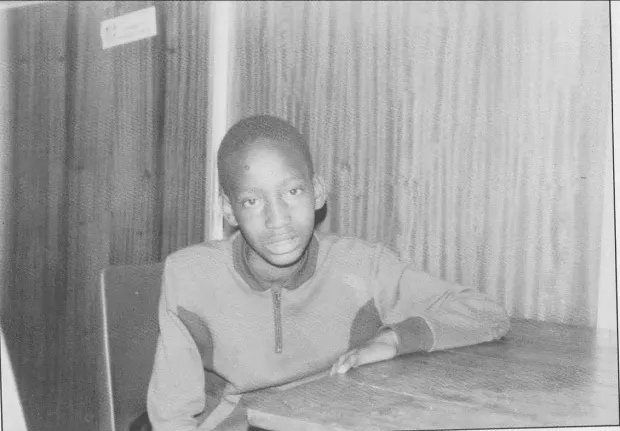
It is 11 July 1985. Winter in Alexandra is not the soft kind. The cold comes up through the soles of your shoes. It lives in the corrugated iron of the shack walls, where the cold settles overnight and doesn’t leave by morning. It sits in the lungs. Smoke from coal stoves makes the air thick by four in the afternoon. A boy, Fanie Goduka, is walking home from school. He is eleven. His jersey is too big, because his mother bought it with growing in mind. That is what mothers did. You
bought a jersey for two winters, maybe three. He has a satchel, and he probably has homework. He has a name, and teeth, and the particular fearlessness of eleven-year-olds who know their street by heart.
He does not get home.
The police van is there. Later, the words “public violence” will be written on a charge sheet. The words are large and hollow. They do not fit an eleven-year-old. They do not fit anyone walking home from school. But the state had decided, by 1985, that the words could be stretched. The state had decided that Alexandra was not a township but a problem. And problems, in the language of security, have to be managed. The next day, 12 July, Fanie stands in the Randburg Magistrate’s Court. He is alone. There is no lawyer, not a guardian in sight. There is a magistrate, policemen, and there is a child. He is asked to make a statement. He makes one. Later, he will say he made it because they pressed him. The word “pressed” is a small word for what it means.
He says they slapped him. He says they kicked him. He says one of the kicks landed on his cheek and took a tooth with it.
The state applies for him to be held. Bail is refused… and again. For two months he is on remand. Two months is July and August. Two months is long enough to miss a term of school. Two months is long enough to learn the sound of a cell door. Two months is long enough for an eleven-year-old to understand that the law is not a shield. Sometimes the law is the boot. On 13 January 1986, the Johannesburg Magistrate’s Court acquits him. The case collapses. The charge of “public violence” cannot be sustained. The law, having taken two months and a tooth, releases Fanie Goduka.
There is no apology. There are no damages. There is only a record, and a boy who is now twelve, and a space in his mouth where a tooth used to be.
Of course, you think this must be unusual. You think a mistake was made. You think someone, somewhere, confused him with someone older, someone guilty of something.
You would be wrong.
To understand the story of Fanie Goduka, you must understand 1985. You must understand the months that came before it, and the laws that made it possible, and the rooms where oppressors decided that children were part of the security problem. On 21 July 1985, ten days after Fanie’s arrest, the State of Emergency was declared in 36 magisterial districts. Alexandra was one of them. This gave the police and the army powers that were already broad and made them total. You could be detained without trial. You could be held for 14 days, renewable. You did not need to be charged or see a lawyer. You did not even need to be an adult.
The Internal Security Act, Section 50, was already on the books. It allowed for preventative detention. The wording was clean but the practice was not. “Preventative” meant arresting people for what they might do. It meant arresting them for where they lived. It meant arresting them for being young, black, in Alexandra, and existing during a time the state had named “unrest.” The Detainees’ Parents Support Committee kept records. They were not
revolutionaries. They were parents who wrote things down because if you did not write it down, the state said it never happened. Their records for 1985 to 1987 show hundreds of children under the age of sixteen in detention. Not accused or convicted, just detained. Some were nine, some were ten, some were twelve. Some, like Fanie Goduka, were eleven. The pattern was not hidden. The South African Institute of Race Relations published it. The newspapers that were not banned published it. An article was published in April 1986, with Fanie Goduka’s story among others. The embassies knew. The churches
knew. The United Nations knew.
What did they do with the children? They held them in police stations, prisons, and sometimes they held them with adults. The law said they should be kept separately. The law said a guardian should be present. Well, the law said many things. They interrogated them. They took statements. The statements were used to detain others. The children became informants by force. Or they became examples. Consider the logic. If you want to break a community, you do not only detain the leaders. Leaders can be replaced. If you want to break a community, you show that you can take the children. You show that there is no age at which the state will hesitate. You show that a school jersey is not a uniform that protects. You show that “public violence” can mean walking.
There were other boys. In September 1985, a thirteen-year-old in Duncan Village was detained for 30 days. His charge was “intimidation.” He had been at a funeral. In October 1985, two twelve-year-olds in the Eastern Cape were held for attending a student meeting. In November 1985, a ten-year-old in Soweto was picked up for “being in a group of more than three.” The group was his cousins. Fanie Goduka was not mistaken for someone else. He was seen clearly. He was
eleven, and that was the point. The police unit involved was the Alexandra Security Branch. Their offices were in the township, close enough to hear the singing from the churches.
By 1985, the Security Branch had a file on every school. They had informants in classrooms. They had lists of “troublemakers.” A troublemaker could be a child who asked why there were no textbooks. A troublemaker could be a child who attended the funeral of a neighbour. A troublemaker could be a child who was on the street at the wrong time.
The courts processed them. Randburg, Johannesburg, Port Elizabeth, Durban. The magistrates saw children and did not stop. The law did not require them to stop. The law required a form, and a signature, and a remand date. The law was kept. The child was not. This is what “state-sponsored kidnapping” means. It means the state takes your child, and it uses its own documents to do it, and it calls it a law, and it tells you that it is for your safety. It means you go to the police station and they tell you he is being held under Section 50. It means you ask when he will be released and they tell you that is not information you may have. It means you come back the next day, and the next, and the next.
It means you get him back in January, and he is quieter, and there is a space where his tooth was, and he does not tell you everything, because how would he?
Freedom Day is 27 April. We all know the footage. The lines that started before dawn. The old women in their best hats, holding their ID books like a Bible. The young men who had been to prison and the young men who had not, standing together. The ink on the thumb. The belief, fragile and huge, that this act would end something.
What was it were we ending?
We were ending a state that made “public violence” out of a walk home from school. We were ending a state that put eleven-year-olds in cells and called it prevention. We were ending a state that believed security meant a child should be afraid of a police van. We voted for a Constitution that says, in Section 28, that every child has the right to be protected from maltreatment, neglect, abuse or degradation. The words are there because of July 1985. They are there because of Fanie Goduka. They are there because of the two months. They are there because a room of people, in 1996, sat down and said: never again will the law be used to take a child and kick him and call it order.
Section 35 says every arrested person has the right to a lawyer. It says you must be brought before a court within 48 hours. It says you must be held in conditions consistent with human dignity. Each clause is an answer to a specific cruelty. Each clause is a ghost of a child who did not have it.
So Freedom Day is not a party. It is a contract.
The contract says: we remember what the state did when it had total power. We remember that it did not stop at adults. We remember that it went to the schools. We remember that it wrote “security” on the cover page of the file and “child” inside it.
The contract says: we measure our freedom by the distance between 1985 and now.
What is that distance? Fanie Goduka would be 52 years old this year. He is a man now. We do not know him. We do not know if he finished school. We do not know if he has children. We do not know if his children walk home from school, and if they do, we do not know if he watches the street until they are inside. We do not know if he still feels the absence in his mouth when he drinks something cold.
Alexandra is still there. The schools are still there. The police are still there. Are they the same? In some ways, no. There is a Constitution. There is a law that says a child must have a guardian present. There is a court that will throw out a statement taken by force. There is a press that can write this piece without being banned. In some ways, yes. Go to Alexandra and ask a mother if she trusts the van that drives past at three in the afternoon. Ask her if she has told her son to keep his hands visible, to not run, to not be in a group. Ask her if she believes the state sees her child as a child.
Freedom is not the absence of the old law. Freedom is the presence of a new reality.
The Truth and Reconciliation Commission heard testimony from children. They spoke of detention. They spoke of assault. They spoke of being made to sign statements they could not read. The TRC used the word “victim.” The state used the word “security.” The distance between those two words is the distance we voted to cross on 27 April 1994. Have we crossed it? There are new forms of violence. There is poverty that keeps children out of school. There is gang violence that makes a walk home dangerous. There is a police service that is undertrained and under-resourced and sometimes brutal. We do not live in 1985. But 1985 is not done with us until we have answered it completely.
To answer it completely, we must say what happened without euphemism. The state kidnapped children. The state tortured children. The state used the law to do it. The state did not do it by accident. The state did it because it believed that if you could make a mother afraid for her eleven-year-old, you could make her afraid of everything. We must say that Freedom Day was the day we decided to be a country where that is illegal, and immoral, and impossible.
We must also say that a law is only as strong as the people who enforce it. A Constitution is only as strong as the memory of why we wrote it. If we forget Fanie
Goduka, we will forget why Section 28 exists. If we forget the two months, we will forget why we insist on 48 hours. There is a habit, when writing about apartheid, to end with hope. Hope is easy. Hope does not demand anything.
I am not writing about hope. I am writing about debt.
We owe Fanie Goduka. We owe all of the other boys. We owe them a country where the police are not a rumour that makes you cross the street. We owe them a country where “public violence” is not a charge you can give to a child. We owe them a country where a magistrate sees an eleven-year-old and sees an eleven-year-old, not a file. We owe them a country where, when we say “Freedom Day,” we can point to the street in Alexandra and say: it is safe to walk home from school here. And mean it. Fanie Goduka was acquitted. That is not justice. Justice would have been not arresting him. Justice would have been not having a law that allowed it. Justice would have been a state that saw a child and felt the obligation to protect, not the opportunity to detain.
We cannot give him back his two months. We cannot give him back his tooth. We cannot give him back the version of eleven that does not include a cell. But, we can give him this: a country that remembers him correctly. Not as “unrest.” Not as “the situation.” As a boy. As eleven. As someone who should have been walking
home, and who was instead taken, and who was instead hurt, and who was instead used to teach his community a lesson about power. Freedom Day began before 1994. It began every time someone wrote down a name. It began every time a parent stood outside a police station and refused to go home. It
began every time a newspaper like printed a story and said: this happened. It began in July 1985, when a boy lost a tooth and the state thought no one would count it.
We counted it. We are still counting.
That is what 27 April means. It means we count. It means we say the age. It means we say the word “kick” and do not look away. It means we say “state” and “child” in the same sentence and understand that the first exists to protect the second, and if it does not, it is not a state worth having.
He was eleven when the state decided he was dangerous.
We are free now because we decided the state was wrong.
Keep deciding it.
-MediaHouse150