 Ayabonga Khanyile and Mfundo Ndima
The twenty year period of 1940 to 1960 seems to have been an interesting developing period contained with de-colonialization and a new world order requiring a fresh caliber of leaders. In Africa, this is a period which saw the leadership of Kwame Nkrumah in Ghana, Samora Machel in Mozambique, Julius Nyerere in Tanzania, Thomas Sankara in Burkina Faso, Oliver Tambo in South Africa, and many other leaders who were tasked with pathing a future for post-colonial Africa.
Simultaneously, in Asia, Singapore was a country battling for its own economic and political independence after a failed merger into Malaysia in 1965. The fallout between the People Actions Party (PAP) and the United Malays National Organization (UMNO) casted a shadow of doubt upon the economic survival of Singapore. In the midst of the uncertainty, the people of Singapore had vowed support for their leader at the time, Lee Kuan Yew.
Yet on comparison basis, many African countries are far behind the development witnessed by people of Singapore from mid-1965. This is obviously an unfair comparison by geography (continent and a country), history (colonialization and territorial/cultural dispute), and people. However, a fair comparison can be made when it comes to individual capacity leadership and commitment of a people to a cause. What did the leaders of Singapore intrinsically realize that African leaders did not?
Leadership debates have to take center stage at some point in the movement of activism-student activism. These are debates which deal with the caliber of leaders desired to advance activism, and have the capacity-moral to path a unifying future for peoples of Africa.
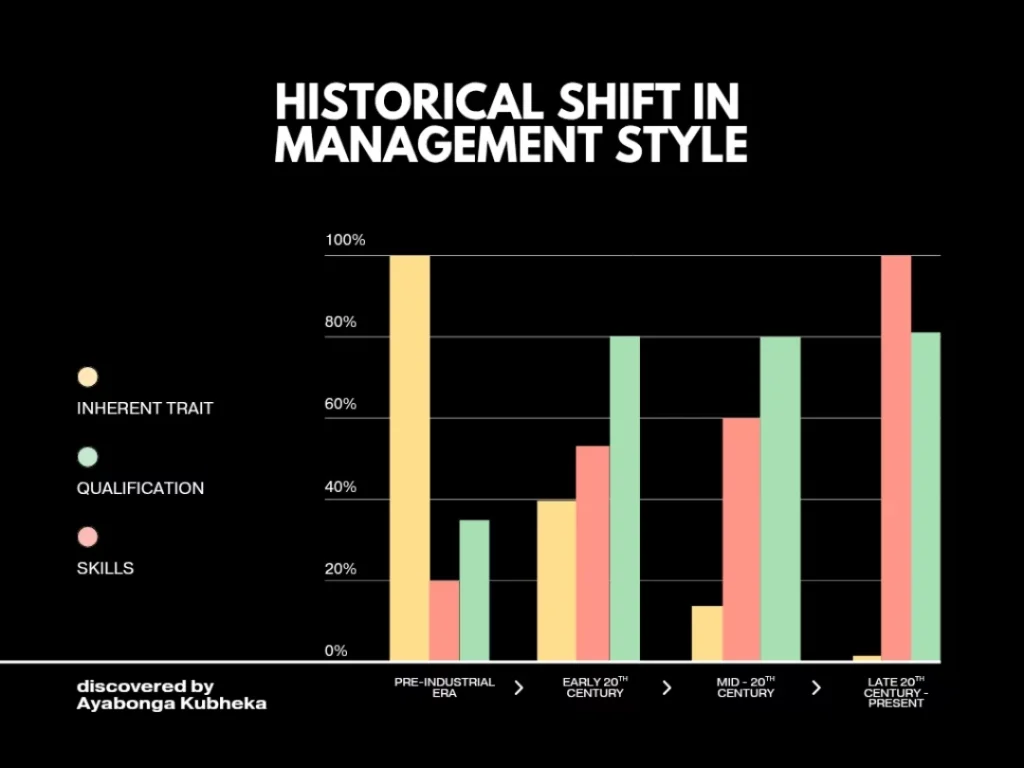
Historical shifts in management styles
Where we are now is a position of reflection into the leadership styles that our African leaders have displayed, how these leadership style affect development in the continent, and historical shift in management styles. Fortunately, there is a good trace of historic shifts in management styles dating back to the pre-industrial era.
In the early approaches of the pre-industrial era, leadership was then considered as an inherent trait, meaning there was a specific person born for a certain role of leadership, e.g. Kings. This style was supported by The Great Man Theory. At some point the management would come up with decisions unilaterally with very little input from internal stakeholders. This style developed with time to the authoritarian /autocratic style of leadership.
With the rise of scientific management in the early 20th century, Frederick Tylor’s principles focused on efficiency that emphasizes standardization, time studies, and task specialization. Yet still, the prevalent management style was to exert a very strict control over operations, with a very clear hierarchy that emphasizes command and control.
The mid-20th century of human relations management, however, came with its own different style of leadership. This was a style based on internal stakeholders needs, because studies like Hawthorne experiments stated the importance of social factors and employee morale. That’s were managers began to notice the employees’ input and hence fostered more democratic leadership styles that favours collaboration and a teamwork environment.
Fast forward to the modern approaches of the late 20th century, nowadays management/leadership emphasizes on teamwork, skills, qualifications, shared decision making and employee empowerment. Leaders now prioritize the needs of their team members to foster a culture of trust and support. They also inspire and motivate both internal and external stakeholders to a common vision.
Questions for African leadership and student activism
Therefore, with this extensive outlook of management style changes over history, where are African business and political leaders stuck in being effective leaders of their countries? In a limited case study of Singapore, with the same timeline of African independence, how have leaders of Singapore been able to build and maintain a developed industrial country in 50 years? Of course, the changes of management styles have been looked through Eurocentric basis of understanding man’s nature. This is due to the lack of understanding African leadership styles from pre-colonial times, and how they would have developed to modernity if it there no epistemic violence against African knowledge production.
Equally, our debates on suitable management styles shouldn’t be in a narrative of accepting one management style while denouncing others. The narrative should be that rooted in pluriversality, or we risk exercising epistemic violence against other peoples’ knowledge. In our limited case study, we can argue that the management style prevalent in Singapore, in Lee Kuan Yew reign was less democratic and more autocratic. Despite this debate, development and transformation is evident in Singapore. How then can we write off autocratic leadership as veil and evil?
This management/leadership style debate is not only important to the people of Africa and the world, but it can be deconstructed and limited to an active group-students. In this post-colonial age, how can students move about branding their own activists leaders and what style of management is sensible for the movement’s cause, de-colonialized education?
The fear should be again failing to present and produce leaders who are capable and revolutionary in African matters. Hence, the debate of leadership should be alluded by students across Africa universities and schools, and by current leaders of African business and politics.
MediaHouse150