 Mfundo Ndima
Economics of development offers a framework in which we can understand why some countries are developed and others underdeveloped. The economic observation over time is that developed countries were able to industrialize firstly by making the agricultural sector productive and sufficient. In doing so, these nations had enough marketable surplus, labour, and capital for foreign exchange.
Agriculture has a critical role in the topic of economic development. This sector provides the kickstart effect once fully developed on its own to distribute proceeds for further growth and development. Agriculture makes four major contributions to economic development: product, market, factor, and foreign contribution. The South African (SA) agricultural sector seems to be contributing well and proves to be on a positive trajectory of distributing its rewards for growth and development to the industry.
This turns the attention to the facilitators of industrialization. The agrarian society is functioning and growing well in our democracy even thou it has massive transformation issues of land reform and colonial legacies. The South African economy needs an aggressive industrial policy reform and investment directed to State owned enterprises and to small private businesses. This policy reform is to facilitate our industrialization inclusively and bring back to life strategic sectors of the economy, specifically, energy and mining.
Four major agricultural contributions to development.
Agricultural factor contribution consists of two aspects: labour and capital accumulation contribution. With sustained levels of productivity in agriculture, the surplus disguised unemployment shifts to the industry. A large part of the workforce tends to shift to non-agricultural activities like communication, research, or legal. The agricultural sector contributes significantly to the capital accumulation which supports industries. The state can also create a taxation system which collects funds and re-invests in infrastructure to facilitate trade or education.
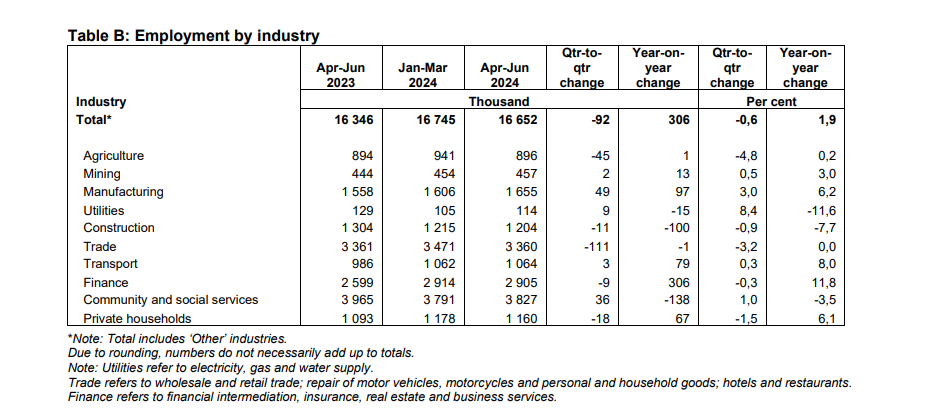
According to Stats SA, of the total 16 million employed persons in SA in 2024, 896 000 persons are employed in agriculture. In fact, most of SA’s labour force is employed in finance (2.5 million), trade (3.4 million), and community and social services (3.9 million). This indicates a clear shift of surplus disguised unemployment from the agricultural sector to the industry concluding a sustained agricultural sector running productively.
Product contribution relates to agricultural industry producing above subsistence levels to feed the labour in the industry and sell agricultural produce at affordable prices either to the industry as inputs or to individual consumers. Marketable surplus (difference between total agricultural produce and subsistence needs) must grow with labour productivity as the demand for more products increases.
The Global Food Security Index ranks SA 59th out of 113 countries, this makes SA the most food secure country in Sub-Saharan Africa. Furthermore, SA’s agricultural exports performed well in 2022. This made SA the 32nd largest agricultural exporter in 2022, also the only African country in the world’s top 40 largest agricultural exporters. This indicates that our agricultural industry produces well above subsistence levels and there’s room of a growing marketable surplus for the industry. Crucially noteworthy, with this gloating statistics there are still many people in our country that go bed hungry simply because of being unemployed and they suffer income poverty.
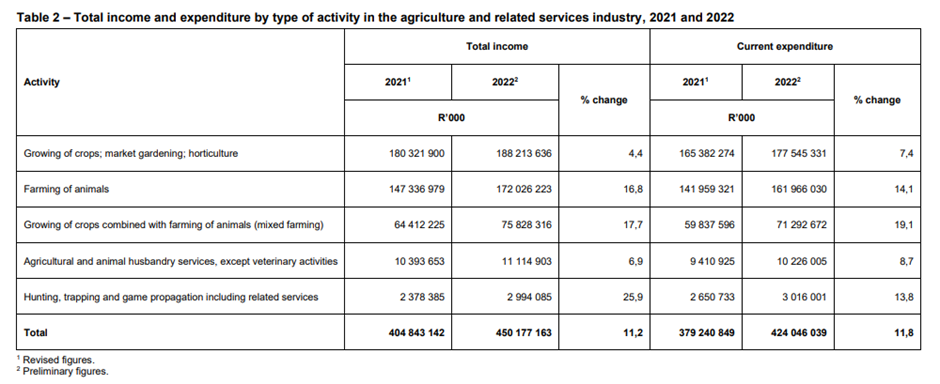
Market contribution of agriculture to economic development occurs through a sustained agricultural industry having a bigger share in autonomous demand of industry produce. Simply put, it must provide a secure market for the industry goods like machinery and transportation. In 2022, the total expenditure incurred by the agricultural industry amounts to R424.1 billion which is a 11.8% increase from 2021. While the total income earned in agriculture and related services industry amounted to R450.2 billion in 2022 which reflected a 11.2% from 2021. This data indicates that SA’s agricultural sector has the capacity of being a market for industrial produce.
Agricultural foreign contribution relates to primary commodities being the basis of our exports to open gateways of other goods that could not be produced within boarders. SA is amongst the top five agricultural exporters in the continent. The potentiality in this space has been utilized through governmental trade agreements like the Africa Continental Free Trade Area (AfCFTA).
Transformation
Amid all this success and sustained development, the South African agricultural industry lack transformation given the history of our political economy. Wandile Sihlobo argues in his book, A County of Two Agricultures, “Nearly three decades after the dawn of democracy, South Africa has remained a country of ‘two-agricultures’. On the one hand, we have a subsistence, primarily non-commercial and black farming segment; on the other, we have predominately commercial and white farmers.” This reality speaks to the democratic failure of land reforms and sector transformation.
Therefore, the consensus in the debate of economic development for SA must be that the economy sits on a positive trajectory to be a develop country with a sustainable agricultural industry. The barriers of development therefore must be in industry which now requires aggressive industrial policy reform and investment. A reform policy to consider economic priorities like state expenditure to infrastructure and basic serves to facilitate industrialization, fighting the root causes of corruption, and solving the economic mystery of SA’s economy to create jobs. Most of the employment is already at the tertiary and industry sector, a willing state investment in human capital and small business unlocks the gateways to a developed country. Amid this, the first state agenda has to be policy reforms and actions that speak directly and proactively to transformation of industrialization and agriculture.
Beyond the agricultural sector being productive, the state must spend in strategic sectors of the economy like mining, energy, transportation, and communications. With state capacity the state controls all the strategic sectors in the economy. For efficiency and a more equitable distribution, the state must make trade possible in small medium size businesses preventing monopolization of industries.
-MediaHouse150