 Mfundo Ndima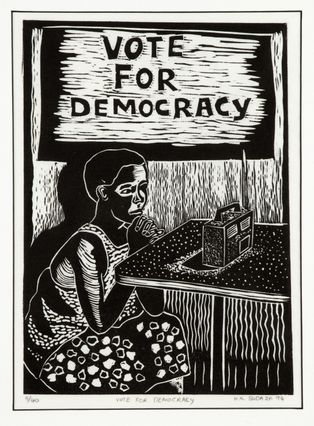
The year 1994 is regarded a political turn around for South Africa, especially for the Black majority. It was the year that would destroy the racially defined boundaries which favoured the white British and Afrikaners. The struggle had long begun in the 16th century, and finally President Nelson Mandela was there to finish the work of Pixley ka Isaka Seme, John Langalibalele Dube, Oliver Tambo and other former struggle leaders of the African National Congress (ANC)
Joyfully and with hope the people of South Africa marched to their voting stations on April 27, 1994, to commemorate the first democratic elections. On December 4, 1996, the constitutional court approves the Constitution of the Republic of South Africa. This document was hope to all people has it was regarded as the “vehicle of transformation.” Now let us reflect and see the fruits of this constitution and what has transpired 29 years later.
The house metaphor by Dale McKinley provides a better and simplified reflection of what has happened in the democratic era. He pictures 20th century South Africa as a house with “foundations embedded in systematic economic, racial and political oppression of the majority of its inhabitants, in the form of apartheid capitalism”. He then stresses the change of political landlord from the National Party (NP) to the ANC, without properly transforming the foundation of the house. Moreover, this reflection provides a better understanding as to what happened in South Africa during the joyful and hopeful moments of the people in 1994. The change that took place was only political and not economical, which resulted in economic inequality, poverty, and unemployment defined by racial lines. This inserts that the ANC betrayed the people’s centred struggle by not changing the foundations of the house, but adopting neo-liberal policies like the Growth, Employment, and Redistribution (GEAR) policy and others
The growth of the youth narrative that “2024 is the youth’s 1994” steams from the unsatisfying reflection of the post-apartheid era in South Africa. The Economic Freedom Fighters (EFF) appear to be leading the youth’s quest for economic emancipation which rectifies the mistakes of the ANC. If one carefully studies the ideological route of the EFF, it easily becomes apparent that they are leading a people’s centred liberation and target to destroy the foundations of the old house and build from the ground up inclusively. The cardinal pillars of the EFF immensely outline how the destruction and construction will be carried over. These non-negotiable pillars are, just to mention a few:
1. Expropriation of land without compensation for equitable redistribution.
2. Nationalisation of mines, banks, and other strategic sectors of the economy.
3. Free quality education, healthcare, houses, and sanitation.
4. Building state and government capacity & others.
These non-negotiable cardinal pillars of the EFF function as the governing force of the organisation and seeks to destroy the foundations built on apartheid capitalism. However, the critic around them has been, are they achievable in Julius Malema reign? How do we fit them on the fragile economy of South Africa? In case of a coalition government, how will the ANC and the EFF reconcile their ideological indifference without causing a toxic political environment? Is the EFF ready to nationally govern?
The fascination and beauty of the EFF political economy ideology is that the state is at the centre and markets are not controlled by profit-maximisations. State market intervention through state owned entities to provide the basic like healthcare and education is vital to any growing economy. This stimulate youth development and creates more jobs in the economy, which is a crisis in South Africa.
The narratives then passes if careful reflection is performed with the ANC in power and its achievements in the post-apartheid era. The youth and the working class have a decision to make in 2024, which is in a few months’ time. Their decision as to, where power resides post 2024 in the national and municipal elections either sees no change, or completely changes the political landscape of South Africa. Therefore, abstaining from voting in 2024 is not a choice.